What Is the Best Lighting for a Kitchen Island?
Discover the best lighting for a kitchen island, from stylish pendant lights to modern fixtures that enhance functionality, create ambience and complement your kitchen design.
By Ruth McKenna


Discover the best lighting for a kitchen island, from stylish pendant lights to modern fixtures that enhance functionality, create ambience and complement your kitchen design.
The best island lighting layers pendants or a linear fitting with recessed and under-cabinet lighting. Pendants are the most popular choice; recessed lighting suits small kitchens and low ceilings. Style choices, from vintage Edison bulbs to minimalist glass, should suit the island’s size and ceiling height.
Hang pendants 75–90 cm above the worktop under a 2.4 m ceiling and use warm white bulbs of 2700K–3000K with a CRI of 90 or more.
The best lighting balances safe prep with evening mood. Three factors decide it: whether the island is a prep station or social bar, its size and your ceiling height. Most family kitchens suit two or three dimmable pendants, recessed lights and under-cabinet lighting. A 1.8 m island under a 2.4 m ceiling may need one or two compact pendants, while a 3 m island under a higher ceiling suits three pendants or a long linear fitting.
Too low causes glare and bumped heads; too high casts shadows. Under a 2.4 m ceiling, hang pendants about 75–90 cm above the worktop, adding roughly 7.5 cm for every extra 30 cm of ceiling. Keep fittings around 15 cm inside the island’s edges, space them 60–75 cm apart centre to centre, and confirm the drop once you know the standard height of your kitchen island.
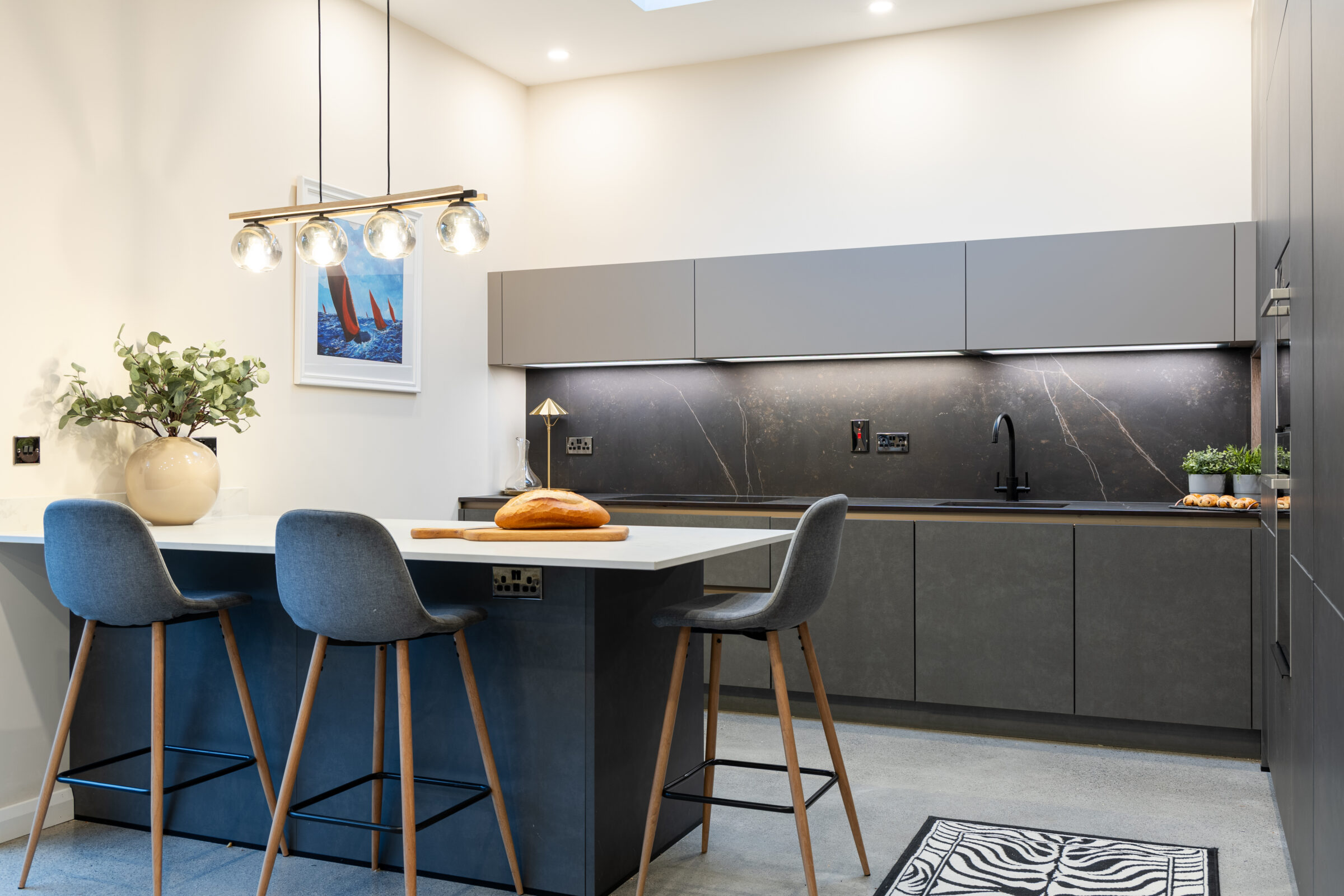
Combined pendant diameters should cover roughly 60–75% of the island’s length. Visual balance matters as much as strict rules, and odd numbers usually look best: one medium pendant for a 1.2–1.5 m island, two or three for 1.8–2.1 m, and three large pendants or one linear light beyond 2.4 m. Prep zones need more brightness than bar seating. If you are still planning the island itself, check how much floor space an island needs.
Island lighting works best within a wider plan of ambient, task and accent light, as our hub guide How Do You Layer Lighting in a Kitchen? explains. Recessed lights banish dark corners, toe-kick strips add evening glow, and dimmers on separate circuits switch the room from cooking to entertaining.
Fittings double as décor. Edison bulbs and metal cages suit industrial schemes, though they need dimmers and back-up task light; slim LED bars and opal globes keep contemporary sightlines open, and brass pendants suit shaker cabinetry. Match finishes to your handles and taps, and consider whether the island should match the cabinets before choosing finishes.
Choose warm white LEDs of 2700K–3000K with a CRI of 90 or more, and around 450–800 lumens per pendant, depending on shade opacity. Frosted bulbs reduce glare over seating, tunable-white LEDs shift from crisp mornings to warm evenings, and quality LEDs last far longer than halogen.
Measure before ordering, keep at least 75 cm between worktop and pendant, and avoid hanging fittings above the hob. Heavy fittings may need ceiling support, so involve a qualified electrician, and choose easy-clean metal or glass. Fittings also add to what a kitchen island costs.
In L-shaped and U-shaped kitchens, follow the island line with pendants or a linear fitting. In compact rooms, petite pendants or recessed lights keep things open, especially if you are fitting an island into a small kitchen. Open-plan rooms suit a striking cluster over the island, while clear glass pendants work well beneath roof lights. Browse our island kitchen designs for inspiration.
Aim for 2,000–3,000 lumens across the island, backed by general room lighting to reduce contrast.
It can be in low-ceilinged kitchens, though most homeowners still want one decorative fitting.
No. They are rarely bright enough for safe chopping.
Use long drops or tall linear fittings.
Share one unifying finish and let the island lead. Still undecided? Read whether you need a kitchen island.