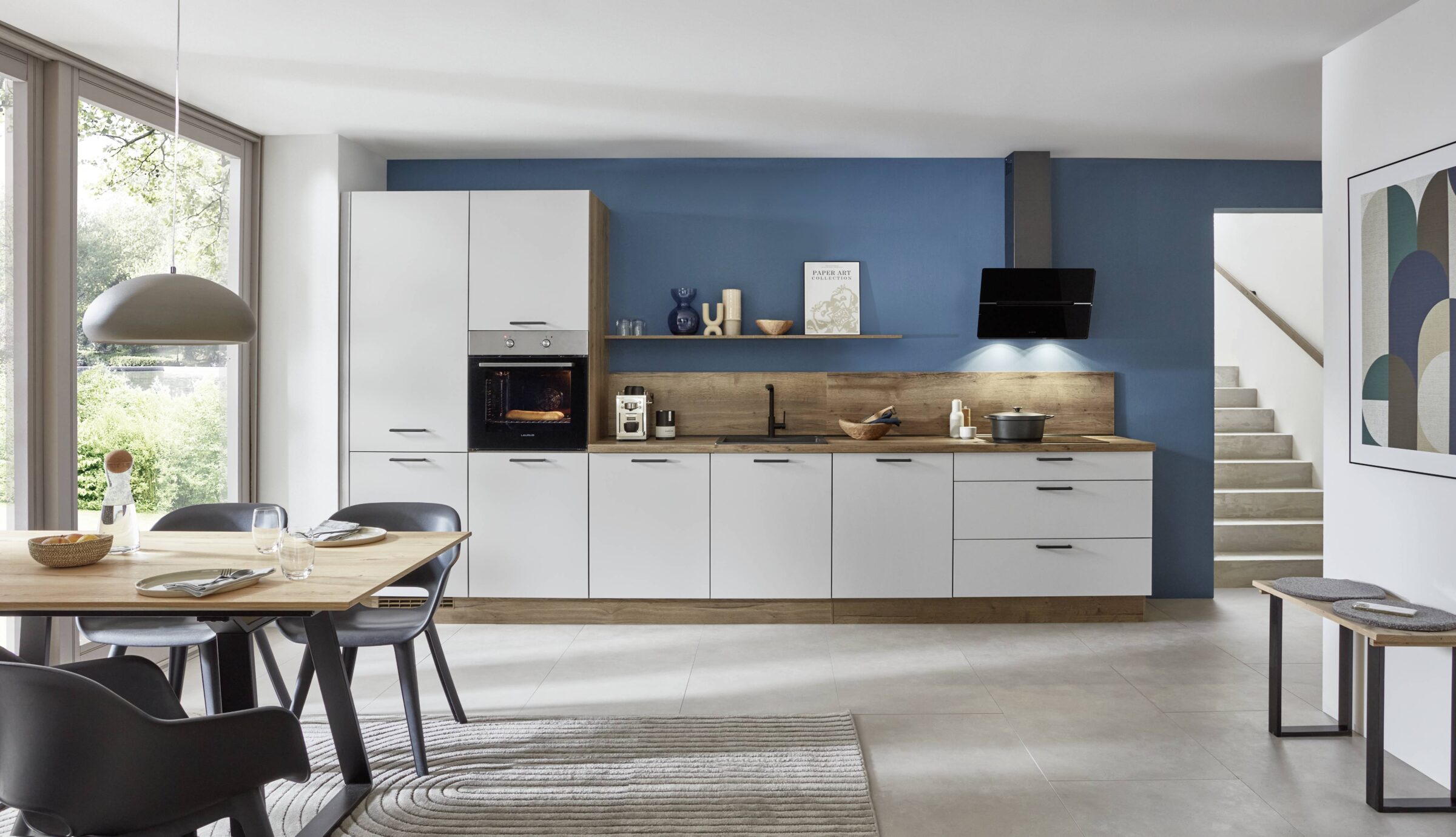
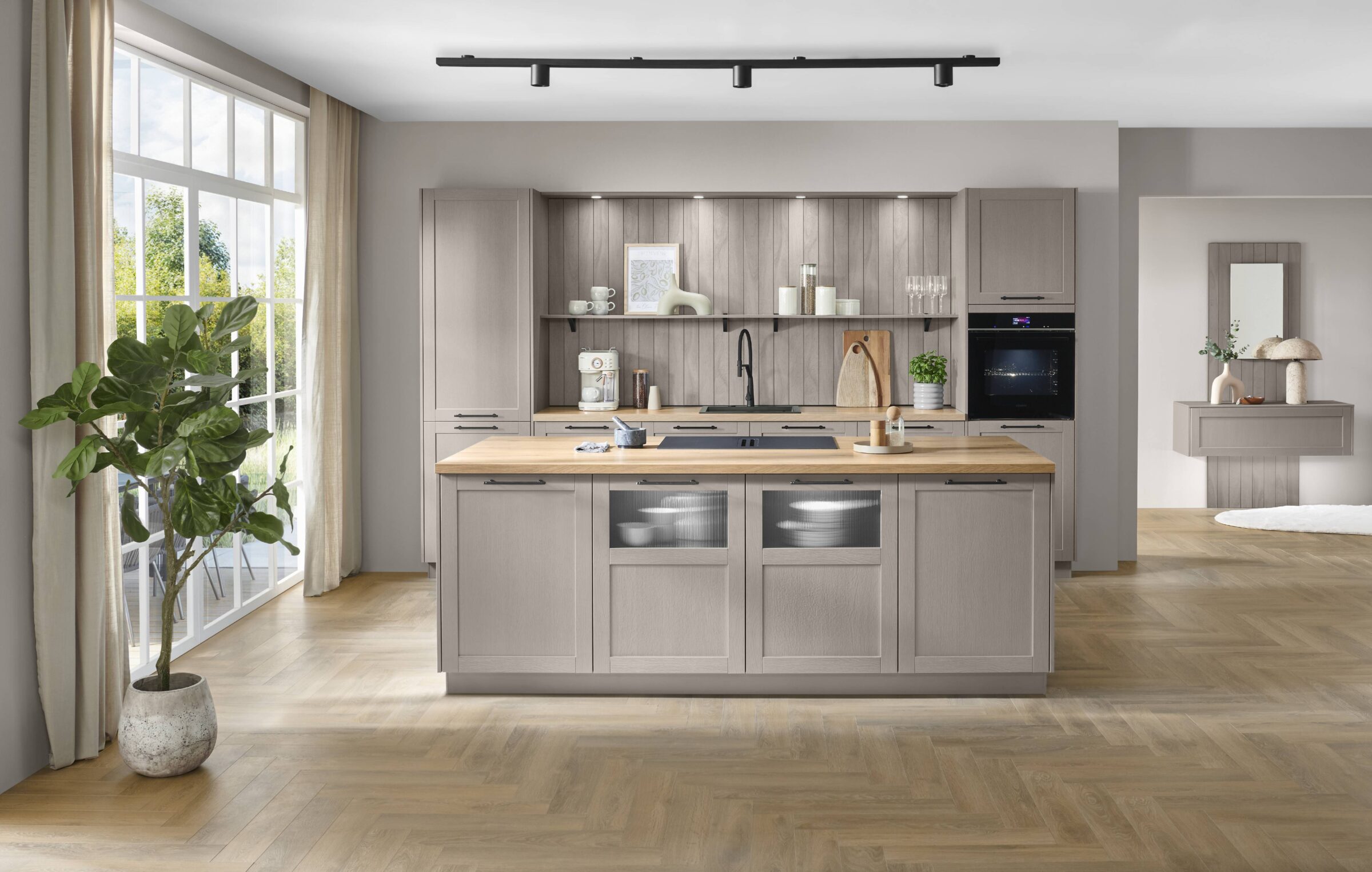
If you’re planning one of our luxury modern kitchens, accurate measurements are the foundation of everything. Measuring your kitchen accurately is crucial for optimal results, ensuring every element fits and functions as intended. No matter how beautiful the finishes or how advanced the appliances, a kitchen only works if the proportions are right. Measuring correctly ensures your layout flows, your cabinetry fits perfectly, and your space feels balanced rather than cramped.
At Kube Interiors, we design and install premium kitchens across Ireland, and one of the most common issues we see is inaccurate early measurements. Whether you’re renovating, extending, or replacing an existing kitchen, this article will provide practical guidance to help you measure properly before meeting your designer. Once you have your measurements, professional kitchen design consultation services can refine the detail and bring your vision to life.
Why Accurate Kitchen Measurements Matter
Luxury kitchen design is about precision. German-engineered cabinetry, seamless handleless runs, stone worktops and integrated appliances all rely on millimetre accuracy. It is important to measure a kitchen carefully before starting any design work, as precise dimensions are essential for planning and remodelling.
Incorrect measurements can lead to:
Poor appliance fit
Awkward gaps between cabinets
Worktop overhang issues
Misaligned islands
Reduced storage efficiency
Even if your designer will carry out a professional survey later, which we always do, having accurate preliminary measurements helps you visualise layout options and budget realistically. Double-checking measurements at this stage prevents costly redesigns later.
Preparation for Measurement
Before you start, take a few simple steps to prepare the space properly.
Clear the room as much as possible. Remove small appliances, stools, freestanding shelving and anything that might obstruct access to walls and corners. This allows you to measure accurately without guessing around obstacles.
Gather your tools:
A metal tape measure, at least 5 metres
Pencil and paper, or graph paper
Spirit level
Laser measure, optional but useful
Smartphone or camera for reference photos
Measure everything in millimetres. This is standard practice in kitchen design and avoids confusion later.
Take your time. These measurements form the basis of your new kitchen design, so accuracy matters far more than speed.
Step 1: Measure the Overall Room Dimensions
Start with the basic structure of the room.
Measure:
The full length of each wall
The width of the room
The ceiling height in several places
Ceilings are not always perfectly level, particularly in older Irish homes. Measure height in at least two or three areas.
Sketch a simple floor plan outline as you go. It does not need to be perfectly to scale. What matters most is that every measurement is clearly recorded.
If the room has alcoves, chimney breasts, boxed-in pipes or recesses, measure each section separately rather than assuming straight lines.
Step 2: Measure Windows and Doors
Windows and doors directly affect cabinetry layout, worktop height and appliance placement.
Record:
Width and height of each window
Distance from the floor to the bottom of the window
Distance from corners to window edges
Door width and height
Door swing direction
Window sill height is particularly important if you are planning a sink beneath the window or running continuous worktops along that wall.
Door swing direction also matters. A poorly positioned tall unit can obstruct access if this detail is missed.
Step 3: Identify Fixed Elements
Some features are structural or expensive to relocate. Mark these clearly on your plan:
Boilers
Soil pipes
Structural columns
Radiators
Fuse box
Gas meter
Water mains
Also mark the location of service points such as plumbing and electrical connections.
If you are unsure whether something is structural, treat it as fixed until confirmed by a professional. Designing around immovable features early avoids unrealistic layouts.
Step 4: Note Plumbing and Electrical Points
Accurately record:
Sink waste pipe
Water supply
Gas line
Extractor vent
Plug sockets
Light switches
Measure the distance from the centre of each point to the nearest wall. This ensures precise placement later.
While plumbing and electrics can sometimes be moved, doing so affects cost and timeline. In many Irish properties, pipe positions significantly influence layout decisions.
Step 5: Check Wall Angles and Floor Levels
Walls and floors are rarely perfectly straight.
Use a spirit level to check:
Whether walls bow
Whether corners are true 90-degree angles
Whether the floor slopes
Even a 10 to 15 millimetre variance can affect cabinetry alignment, particularly in handleless systems or when installing stone worktops.
If you notice irregularities, note them clearly on your plan. This helps your designer anticipate potential adjustments.
Step 6: Consider Clearance Space
When planning your kitchen layout, always consider clearance space to ensure comfortable movement and usability.
Allow space for:
Appliance door opening
Fridge door swing
Dishwasher drop-down
Island walkway clearance
As a general rule:
Minimum walkway: 900 millimetres
Comfortable walkway: 1,000 to 1,200 millimetres
Around an island: ideally 1,000 millimetres or more on all sides
Ignoring clearance is one of the most common layout mistakes. A kitchen may look beautiful on paper but feel cramped in daily use if walkways are too tight.
Step 7: Think Vertically
Luxury kitchens often maximise height with tall units and full-height cabinetry.
Measure:
Ceiling height
Bulkheads
Downstands
Beam positions
If you are planning tall cabinetry, integrated lighting channels or feature ceiling details, vertical measurements are just as important as floor dimensions.
Step 8: Photograph Everything
Take clear photos of:
Each wall
Ceiling
Floor
Utility points
Any awkward angles
Photos provide visual context that numbers alone cannot. Designers often spot details in images that might not be obvious in a sketch.
Creating a Clear Floor Plan
Once your measurements are complete, create a clean and organised sketch.
Draw the room shape and clearly label:
All wall lengths
Window and door positions
Fixed objects
Plumbing and electrical points
Ceiling height
Include notes about anything unusual, such as sloping ceilings, boxed-in pipes or uneven walls.
This sketch forms the foundation for your kitchen design conversation.
How Designers Use Your Measurements
When you bring your measurements to your design consultation for luxury kitchens, your designer will:
Recreate the room digitally
Produce a clear plan of your new kitchen layout
Suggest layout improvements
Adjust proportions
Conduct a full technical survey before ordering
Kitchen design consultation services often include a planning appointment with expert advisors and a home measure visit to confirm all dimensions professionally.
Your measurements start the conversation. The professional survey finalises the detail.
Verifying Measurements
Before finalising your sketch, double-check everything.
Measure each wall at least twice. Work methodically around the room, starting from one corner and moving clockwise.
Pay close attention to:
Vertical distances
Window heights
Door widths
Corner angles
Using a level ensures your measurements are straight and accurate, particularly where cabinetry will meet walls or ceilings.
Recording precise dimensions at this stage significantly reduces the risk of later design changes.
Common Measuring Mistakes to Avoid
Measuring in centimetres instead of millimetres
Forgetting window sill height
Ignoring door swing direction
Not accounting for skirting boards
Measuring only once
Precision saves time, money and frustration.
Measuring for an Island
If you are considering an island, calculate available space carefully.
1. Measure total room width.
2. Subtract 2,000 to 2,400 millimetres for clearance, allowing 1,000 to 1,200 millimetres on both sides.
3. The remaining space is your maximum island depth.
For example:
Room width: 4,500 millimetres
Minus clearance: 2,000 millimetres
Island depth possible: 2,500 millimetres
Proportion matters as much as space. An oversized island can dominate a room visually, even if it technically fits.
Finalising Your Measurements
With your measurements verified, organise them clearly and prepare for your consultation.
Ensure your plan shows:
Room dimensions
Door and window locations
Plumbing and electrical points
Ceiling height
Fixed structural elements
Consider how permanent fixtures such as beams or pillars affect flow and layout.
Providing complete and accurate information allows your designer to develop a layout that feels balanced, practical and refined.
A Well-Measured Kitchen Sets the Stage for Exceptional Design
A well-measured kitchen becomes a well-designed kitchen. Accurate dimensions allow your designer to create balance, symmetry and flow, which are the hallmarks of a truly premium space.
Bring your measurements, your ideas and your inspiration. The rest is where expertise transforms numbers into something exceptional.