Every kitchen design ages eventually, but some choices age much faster than others. This guide walks through the layouts, cabinets, surfaces, lighting, appliances, and decor that tend to date a kitchen fastest heading into 2026, along with practical ways to update them without starting from scratch.
Key Takeaways
- Many all-white kitchens, granite countertops, and 2000s farmhouse details now date a space instead of creating a dream kitchen.
- Outdated kitchen design is as much about layout, lighting, and storage as it is about finishes like cabinets and hardware.
- Small changes, such as lighting, hardware, paint, and worktops, can fix big design mistakes without a full kitchen remodel.
- Timeless kitchen styles usually mix warm materials, layered lighting, and practical, integrated appliances.
- Working with a clear plan, or an interior designer, helps avoid trends that will feel tired again by 2030.
Introduction: What Makes a Kitchen Look Outdated in 2026?
An “outdated kitchen” in 2026 usually means a combination of era-specific markers: 1990s cherry cabinetry paired with dark granite, Tuscan arches and heavy corbels, fluorescent lightboxes, and a microwave sitting in plain sight on the counter or hanging over the range.
The goal here isn’t to shame older kitchens. Plenty of well-built kitchens from past decades still function perfectly well; the point is to help readers work out which elements to change first if they’re planning a remodel, rather than guessing or replacing everything at once.
Common offenders tend to repeat across homes: all-white kitchens with no texture, spotty granite countertops, bulky vent hoods, awkward or oddly shaped islands, poor lighting, and a lack of integrated appliances. Updating these elements supports resale value and everyday comfort, especially in open-plan homes where the kitchen is visible from the living and dining areas. The rest of this guide is organised by category: layout, cabinets, worktops, lighting, appliances, and decor.
1. Layouts and Features That Date a Kitchen
Layout is the backbone of any kitchen, and even expensive finishes can’t hide a floor plan that was designed around how people cooked and entertained in the 1990s.
Closed-off U-shaped kitchens from the 1980s, peninsula layouts from the 1990s, over-the-range microwaves, and wonky, oddly proportioned islands are some of the most concrete giveaways. A dream kitchen in 2026 prioritises clear traffic flow, enough worktop space, and a right-sized island without strange angles or bar-height split levels. Modern layouts increasingly favour semi-open concepts with some zoning, rather than going fully open-plan or fully closed off. Later sections in this guide cover how to fix layout issues without knocking down every wall, such as replacing a peninsula with a compact island.
1.1 Closed-Off or Over-Open Floor Plans
Fully closed galley kitchens with a single doorway tend to feel dated compared with lighter, more connected spaces, since they cut the kitchen off from the rest of the home both visually and socially.
At the same time, the “remove every wall” open-concept trend that took off through the 2010s is softening. Many homeowners now want some partial separation, mainly to contain noise and cooking smells rather than living entirely in one undivided room.
A wide opening, an interior window, a half wall, or a double-sided storage unit can often achieve that balance without resorting to total demolition.
Using the kitchen island, or a peninsula with a built-in bookshelf, as a soft visual divider between the cooking and living zones is another way to create separation without closing the space off completely.
1.2 Peninsula Kitchens and Awkward Islands
1990s-style peninsulas, especially ones with upper cabinets hanging over them, now read as cramped and old-fashioned compared with a freestanding island.
“Wonky” islands are a related problem: odd angles, curves, tiered bar tops, or islands so small they end up blocking the main walkway instead of helping the room function.
It’s worth prioritising clear walkways of around one metre, or roughly 40 inches, and choosing a simple rectangular island sized properly to the room rather than squeezed in.
Swapping a dated peninsula for a well-proportioned, narrow island can modernise the whole space and make the kitchen far more sociable, since people can sit or gather around it from more than one side.
1.3 Traditional Formal Dining Zones Right Beside the Kitchen
A separate, formal dining table that rarely gets used can date the whole kitchen-dining area, especially when it sits awkwardly between the kitchen and the rest of an open-plan space.
Modern alternatives include built-in banquettes, breakfast nooks, or counter-height seating built into the island itself, all of which tend to get used far more often than a formal table.
Multifunctional seating that works for a quick breakfast as well as casual entertaining tends to suit the way most households actually use a kitchen-dining space today.
It’s worth rethinking any oversized dining furniture that blocks light or circulation near the kitchen, even if it was a centrepiece when it was first chosen.
2. Cabinet Styles and Storage Details That Feel Stuck in the 2000s
Cabinets are the largest visual surface in most kitchens, so outdated door styles and trims can time-stamp the whole room almost instantly.
Specific eras are easy to spot once you know what to look for: orange oak finishes from the 1990s, heavily glazed Tuscan-style doors from the early 2000s, and intentionally distressed paint finishes from the mid-2000s. Current kitchen styles favour cleaner profiles, such as Shaker, slab, or simple beaded frames, with minimal rope trim or carved onlays. Extending cabinets up to the ceiling and simplifying the moulding is often more effective, and far less disruptive, than a full cabinet replacement.
2.1 Short and Varied-Height Upper Cabinets
The 1990s through 2010s trend of 30-inch upper cabinets, often with a dust-collecting gap above and randomly staggered heights, is one of the clearer markers of an older kitchen.
In 2026, a continuous line of taller wall cabinets, generally around 36 to 42 inches or extended all the way to the ceiling, looks considerably more custom and current.
Adding simple “stacked” boxes above existing cabinets has become a popular partial-remodel solution for households that don’t want to replace everything.
Beyond the visual update, vertical storage supports a more functional kitchen overall and makes the ceiling feel higher than it actually is.
2.2 Heavy Traditional Details and Faux Distressing
Rope trim, fluted columns, large corbels, carved appliqués, and intentionally distressed or glazed finishes were all popular in Tuscan and rustic farmhouse kitchens from roughly 2000 to 2010.
Swapping these for flat valances, simple square posts, and plain crown moulding gives a far more timeless look without losing the cabinetry itself.
In many cases, a quick repaint in a neutral or muted colour, combined with new hardware, can rescue otherwise solid cabinet boxes that just look dated on the surface.
2.3 Too Much Open Shelving, Not Enough Closed Storage
Full walls of open shelving, which were everywhere between roughly 2015 and 2020, now tend to feel high-maintenance and prone to clutter rather than aspirational.
A few open shelves for display are fine, but replacing all of the upper cabinets with open shelving usually backfires once daily life and dust take over.
Mixing closed cabinets with a limited run of open shelves, or glass-front doors, tends to give a more balanced kitchen design that still feels current.
A genuine dream kitchen hides most of the everyday chaos, mismatched mugs, half-used boxes, spare batteries, behind doors and drawers rather than out on display.
2.4 Chrome and Builder-Grade Hardware
Ultra-shiny chrome pulls and overly ornate knobs can instantly age an otherwise updated kitchen, even when the cabinet boxes and doors themselves are in good shape.
Brushed nickel, warm brass, or mixed metals chosen to coordinate with the tapware and lighting are common, longer-lasting alternatives.
Simple, substantial handles tend to read as more current than tiny, fussy knobs, which can feel distinctly 1990s next to an otherwise modern kitchen.
Matching outlet covers and hinges to the main metal finish in the room helps tie everything together into one cohesive, modern look.
3. Countertops, Backsplashes, and Sinks That Give Away the Age
Worktops and splashbacks are some of the more expensive surfaces to change, but they have an outsized impact on how current a kitchen feels.
Some once-premium choices, such as spotty granite countertops, 4×4 tumbled stone tiles, and busy mosaic backsplashes, now read as dated rather than luxurious. Modern dream kitchens are leaning toward quieter stones, large-format tiles, and fewer grout lines overall. If you can only update one or two major surfaces, worktops and splashbacks are usually worth prioritising over smaller details.
3.1 Spotty Granite Countertops and Bullnose Edges
Classic early-2000s granite, with high movement, busy patterning, and a rounded bullnose edge, tends to make a kitchen feel visually noisy and darker than it needs to be.
Upgrading to quartz, porcelain, or a solid surface with simpler patterning and an eased or square edge profile is a common way to modernise the room.
Even changing just the island countertop, rather than every surface in the kitchen, can significantly shift how current the whole space feels.
3.2 Laminate or Tiled Worktops with Grout Lines
Laminate worktops with a wood trim, or small square tile countertops, were common through the 1980s and 1990s and are now one of the more obvious age markers in a kitchen.
Grout lines and peeling edges not only look dated, they’re genuinely harder to keep clean over time, which compounds the issue.
Modern, durable alternatives include quartz, compact laminate, porcelain slabs, or butcher block accents for warmth on an island or single section of counter.
Choosing a neutral, low-pattern surface tends to work better long-term, since it will sit comfortably with several future colour schemes rather than locking the kitchen into one specific look.
3.3 Overused Granite and Real Stone in 2026
Granite as a material isn’t “bad,” but certain dark, heavily speckled colours now feel passé compared with quieter stone patterns.
Real marble and other porous stones demand regular sealing and ongoing stain vigilance, which many busy families find genuinely impractical day to day.
Engineered options, such as quartz, sintered stone, or composite surfaces, can deliver a similar look with considerably easier maintenance.
It’s generally worth focusing on longevity and ease of cleaning rather than chasing one specific stone name purely for status.
3.4 Subway Tiles, Framed Backsplashes, and Busy Mosaics
Plain white 3×6 subway tile and framed “feature” backsplashes were heavily overused from roughly 2010 to 2020, to the point where they now read as a specific era rather than a neutral choice.
Other dated combinations include 4×4 travertine with accent “dots,” or stripy linear glass mosaics behind the hob, both of which were common a decade or more ago.
Larger-format tiles, simple stacked layouts, or subtle surface textures tend to read as more current than a strong, busy pattern.
Keeping the splashback relatively calm gives you more freedom to change paint colours, bar stools, or rugs later on without anything clashing.
3.5 Double-Bowl Sinks with High Dividers
Deep, double-bowl stainless sinks, popular through the 1990s, now feel less practical for big pots, pans, and trays, which simply don’t fit well in a divided basin.
A large single-bowl sink, or a low-divide model, tends to support modern cooking and entertaining far better than the old high-divider style.
Workstation and galley-style sinks are a current option that add integrated accessories, such as cutting boards and drying racks, directly into the prep area.
Choosing a sink material and finish that harmonises with the countertop and tapware helps the whole worktop area feel like one considered design rather than separate purchases.
4. Lighting Choices That Instantly Age Your Kitchen
Kitchen lighting is one of the fastest ways to tell whether a kitchen was updated before or after roughly 2010, often faster than the cabinets or worktops themselves.
Fluorescent lightboxes, oversized recessed can lights, and heavy industrial pendants are some of the clearest outdated elements to look out for. A layered approach, combining ambient, task, and accent lighting, is essential in current kitchen design. Updated lighting alone can make even older cabinets and granite countertops feel noticeably fresher.
4.1 Fluorescent Lightboxes and 6-Inch Cans
Classic fluorescent troffer boxes from the 1980s and 1990s flatten colour and create a fair amount of glare, which is part of why they feel so dated under any other lighting.
Large 6-inch recessed cans also read as distinctly 1990s to early-2000s in many homes, even where the rest of the kitchen has been updated.
Switching to smaller LED recessed fixtures, generally around 3 to 4 inches, with a warm colour temperature tends to modernise a ceiling significantly.
Adding dimmers and zoning different areas separately means task areas can stay bright while a dining or seating area can be kept softer.
4.2 Oversized or Heavy Industrial Pendants
Huge barn-style pendants and chunky black industrial shades peaked in popularity in the late 2010s and can now feel heavy-handed in an otherwise updated kitchen.
Oversized pendants can overwhelm a modest-sized island and cast awkward shadows across the worktop, which is more of a functional issue than a purely stylistic one.
More refined options include slim linear fixtures, a pair of medium-sized pendants, or sculptural globe shapes that give a similar amount of light without the bulk.
It’s worth coordinating pendant finishes with the cabinet hardware and taps in the room, without forcing an exact match across every metal surface.
4.3 Lack of Under-Cabinet and Task Lighting
A single ceiling fixture with no under-cabinet lighting at all is typical of older kitchens and tends to leave the actual worktop in shadow while you’re cooking.
LED strips or pucks fitted beneath the upper cabinets illuminate the worktop directly and make even a modest kitchen look considerably more high-end.
Warm white LEDs that match the general ambient lighting in the room give a more cohesive effect than mixing cool and warm light sources.
Adding task lighting is generally a low-disruption upgrade, which makes it one of the easier wins during a partial kitchen remodel.
5. Appliances and Technology That Signal an Outdated Kitchen
Appliances influence both how a kitchen functions and how old it looks at a glance, sometimes more than the cabinets do.
Visible microwaves, mismatched finishes, and bulky over-the-range units are some of the most consistent dating elements. Modern dream kitchens favour integrated appliances and clean sightlines along the worktops. Energy efficiency and smart controls, even subtle ones, tend to read as signs of a current, thoughtfully planned kitchen.
5.1 Over-the-Range Microwaves and Visible Microwaves
Installing a venting microwave directly above the hob or range was common practice through the 1990s and 2000s, but it places a hot appliance at eye level in a way that feels both stylistically and functionally outdated.
These units also tend to look bulky and vent poorly compared with a proper extractor hood designed for the job.
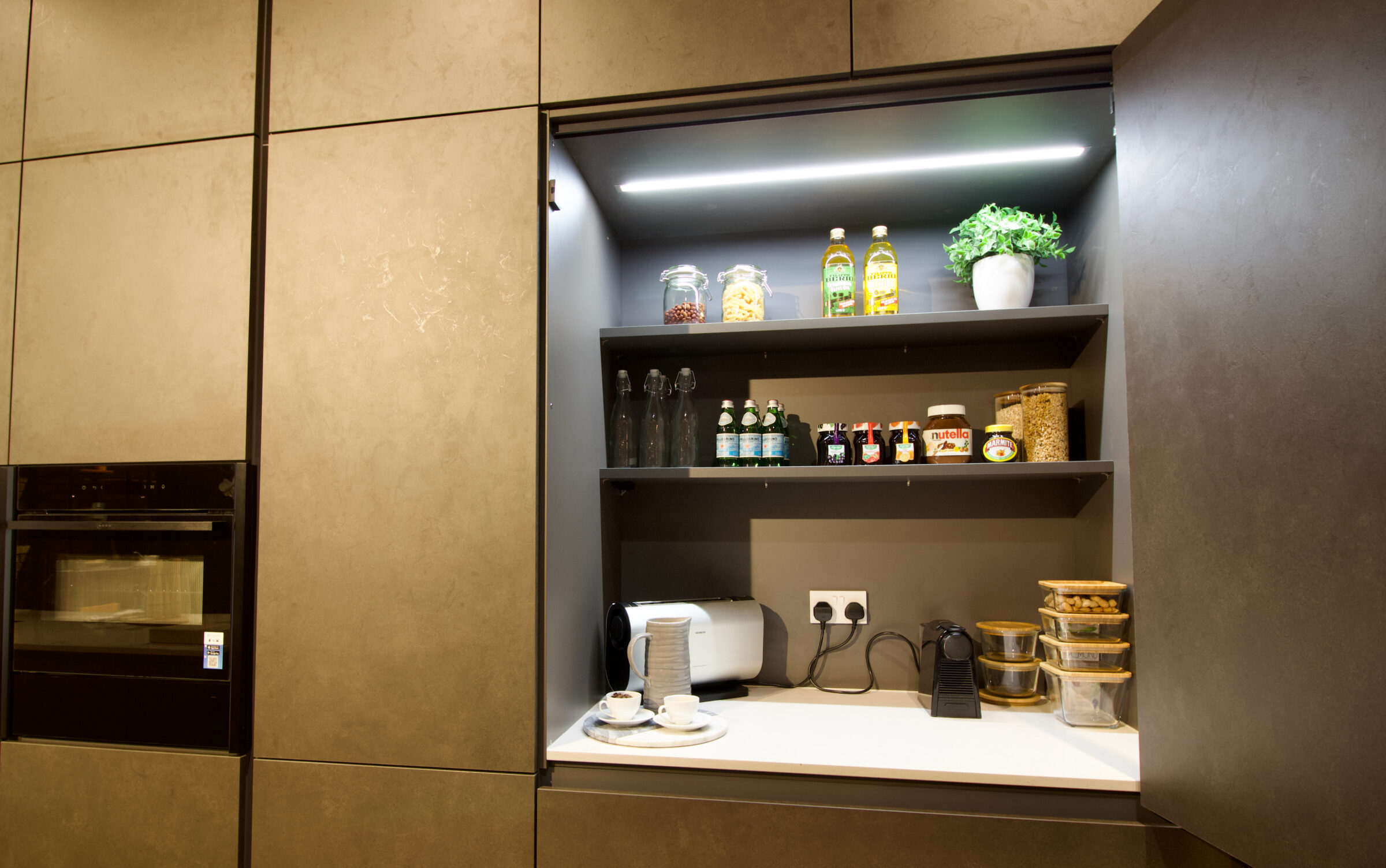
Microwave drawers, built-in wall niches with doors, or housing the microwave inside a pantry cabinet are all common ways to remove it from sightlines while keeping it convenient.
Simply removing a visible microwave from the countertop or eye-level position tends to declutter a kitchen’s appearance almost immediately.
5.2 Non-Integrated, Mismatched, or Old Appliances
White or almond appliances from the 1990s, visibly yellowed plastics, and loud exhaust fans can age a kitchen instantly, even when everything else in the room has been updated.
A fridge with no surrounding cabinetry can look like an afterthought rather than part of a cohesive design, particularly in an open-plan space where it’s visible from multiple angles.
Panel-ready dishwashers and fridge-freezer units are worth considering where the budget allows, or at minimum, surrounding standard appliances with tall cabinetry to integrate them visually.
Even updating just the cooker hood to a simpler, more sculptural form can noticeably change how the whole kitchen feels.
5.3 Lack of Smart or Practical Tech
Not every household needs “smart everything,” but a total absence of modern features can make a kitchen feel behind the times in a way that’s hard to pin down.
Practical updates worth considering include induction hobs, quieter dishwashers, touchless taps, and hidden charging drawers built into a cabinet.
Using technology to support daily routines, rather than chasing novelty for its own sake, tends to age far more gracefully over the following decade.
Wiring for future technology, such as extra outlets, USB-C points, and dedicated smart lighting circuits, is generally a wise addition during any remodel, even if you don’t use all of it immediately.
6. Color Schemes and Decor That Date Your Kitchen
Colour and decor are usually easier and cheaper to change than cabinets or worktops, but they can still make a kitchen feel firmly stuck in a past decade.
All-white kitchens, all-grey schemes, word art, and excessive themed decor are some of the most common culprits. Today’s dream kitchen tends to blend warm neutrals, natural textures, and far fewer “cute” accessories than a decade ago. It’s also worth thinking about how the kitchen connects visually to the rest of the home’s interior design, rather than treating it as a completely separate room.
6.1 All White Kitchens Without Texture or Warmth
An all-white kitchen from the 2010s, white cabinets, white worktops, and a white splashback, can feel cold and clinical by 2026 standards.
The real issue isn’t white itself; it’s the lack of contrast, texture, and natural elements that often goes along with an all-white scheme.
Easy updates include wood bar stools, warmer metal hardware, a textured splashback, or a contrasting colour on the island.
Repainting in off-whites, creams, or greige tones, rather than a stark, blue-white shade, also tends to feel warmer and more current.
6.2 All Grey, Dark Cherry, and Orange-Toned Wood Schemes
Flat, all-grey kitchens and 2000s-style dark cherry wood paired with black granite both feel heavy by current standards.
Orange-toned oak from the 1990s is another strong visual cue of an older build or a last remodel that’s overdue for an update.
Sanding and restaining wood to cooler, more natural tones, or painting cabinets in muted colours like sage, navy, or mushroom, are both common ways to move past these schemes.
Combining wood with painted elements, rather than committing to one strong tone across every surface, generally ages better over time.
6.3 Word Signs, Gimmicky Decor, and Over-Themed Styles
Mass-produced word art, things like “Kitchen,” “Eat,” or “Live Laugh Love” signage, is one of the more common outdated decor elements still found in many homes.
Highly themed looks, whether Tuscan overload, 1990s farmhouse with rooster motifs, or coastal clichés, tend to date quickly compared with a more neutral base.
Swapping word signs and novelty items for simple framed art, ceramics, or textiles that genuinely reflect the homeowner’s taste tends to age far better.
Editing countertop decor down to a few meaningful pieces, rather than several small trinkets, also reads as more current and intentional.
6.4 Rustic Farmhouse and High-Contrast Black-and-White Extremes
Shiplap walls, barn doors inside the kitchen, and heavily distressed “farmhouse” pieces peaked in popularity before roughly 2022 and have since started to feel overdone.
Very harsh black-and-white palettes with little warmth are also fading in favour of softer, more layered neutral schemes.
Evolving a farmhouse-inspired kitchen toward cleaner cabinetry, natural wood, and a few handmade details, rather than obvious decorative props, tends to keep the style feeling current.
Balancing contrast with tactile materials like wood, stone, and linen generally gives a more timeless, considered look than relying on stark colour contrast alone.
7. How to Update an Outdated Kitchen Without Starting From Scratch
For readers who recognise several outdated elements in their own kitchen but can’t take on a full gut remodel, this section is a practical roadmap built around “high-impact, lower-disruption” projects that can be tackled in phases over roughly six to 24 months.
These updates connect directly back to the categories covered earlier: lighting, hardware, paint, worktops, and layout tweaks. Planning ahead, or working with an interior designer from the start, helps avoid spending money on a trend that will feel just as dated again in a few years.
7.1 Prioritize the Biggest Visual Offenders
A useful starting point is to list every outdated feature in the kitchen, then rank each one by how much it actually bothers you, what it would cost to fix, and how much it affects daily use of the room.
Common starting points include fluorescent lightboxes, spotty granite, heavily glazed cabinets, and a visible microwave, since these tend to have an outsized visual impact relative to their cost.
Focusing the budget on one or two major elements, rather than spreading it thinly across a dozen small, low-impact details, tends to produce a far more noticeable result.
Gathering photos of kitchens you genuinely like is worth doing before spending anything, since it helps keep every decision pointed in the same cohesive direction.
7.2 Quick Wins: Paint, Hardware, and Lighting
Repainting the cabinets, the walls, or just the island can reset an entire outdated colour story without touching the layout or the cabinet boxes themselves.
Swapping out chrome hardware and dated taps for more contemporary finishes is one of the more budget-friendly refreshes available.
Updating the pendants over the island and adding under-cabinet LED lighting often changes the overall mood of the room more dramatically than people expect.
Coordinating these quick wins into a single weekend or short project phase tends to give a clearer sense of transformation than spacing them out over many months.
7.3 Bigger Moves: Worktops, Backsplash, and Layout Tweaks
For a bigger phase, it’s generally worth planning to replace the countertops and splashback together so the result feels cohesive rather than mismatched.
Choosing simple, durable materials that can support several future paint or hardware changes gives the kitchen more flexibility down the line.
Modest layout improvements, such as removing a peninsula, resizing the island, or adding taller wall cabinets, can also be planned into this phase without a full structural overhaul.
Rethinking appliance placement, particularly the microwave and the fridge surround, is often what finally moves a kitchen firmly into the 2020s rather than leaving it half-updated.
If the floor is part of what’s bothering you about the room, it’s worth tackling at the same time as the worktops and splashback rather than as an afterthought. Our guide on what type of flooring is best for a kitchen breaks down which materials, from tile to vinyl to engineered wood, hold up well and stay looking current for the longest.
If you’d like to see current cabinet finishes, worktops, and flooring in person before committing to anything, our kitchen showrooms Dublin location has live kitchen displays you can walk through and compare side by side.
Frequently Asked Questions
How do I know if my kitchen is outdated or just “classic”?
Classic kitchens usually have simple cabinet profiles, neutral worktops, and balanced lighting, even when they’re older. Obvious era markers, such as fluorescent boxes, orange oak, busy granite, heavy corbels, or an over-the-range microwave, generally point to an outdated space rather than a classic one. It can help to compare your kitchen against photos of current kitchens you like; if a major element doesn’t appear in any of your inspiration images, it’s probably worth updating. Focusing on function first is also worth doing: if the layout and storage still work well, style updates can be layered on gradually rather than all at once.
Which outdated kitchen features should I update first on a tight budget?
Starting with high-impact, low-cost changes, paint, new hardware, and updated lighting, tends to give the best return for the money. Removing word signs, decluttering the worktops, and hiding small appliances can also make a surprising difference for very little spend. Tackling a visible microwave and any especially dated taps is worth prioritising too, since both strongly influence the overall first impression. Bigger expenses, such as new worktops and flooring, are generally better saved for a second phase once your priorities are clearer.
Are all white kitchens really “out of style” now?
White cabinets themselves aren’t obsolete, but a flat, all-white kitchen with no warmth or texture does feel less current in 2026 than it did a decade ago. Adding wood accents, mixed metals, colourful textiles, or a contrasting island can update an existing white kitchen without a full replacement. There’s no need to rip out good-quality white cabinetry if you still like it; layering in warmth and a bit of personality is usually enough. The key is avoiding a sterile, one-note look rather than avoiding white altogether.
Is granite completely outdated for kitchen countertops?
Granite as a material is still genuinely durable, but certain dark, heavily speckled patterns and a chunky bullnose edge do feel dated next to current kitchen styles. Quieter, more uniform stones, whether granite, quartz, or porcelain, tend to fit better with the look most homeowners are going for now. If you’re keeping or choosing granite, a honed finish and a simple edge profile will generally read as more current than a glossy, ornate edge. How the stone looks and performs in your specific kitchen matters more in the end than following any single trend rule.
How often should I plan to update my kitchen to avoid it looking dated?
Most homeowners refresh some aspect of their kitchen every five to seven years, with full remodels happening more like every 12 to 20 years. Small, regular updates, paint, lighting, and hardware, tend to work better than waiting for one single massive project. Choosing timeless base elements, the cabinet style, the layout, and the major worktop colour, means future updates can mostly stay cosmetic rather than structural. Designing for how you actually live now, with enough flexibility for changing tastes over the next decade, tends to age the best overall.